
 NEWS
NEWS
Turkmenistan Becomes a Pioneer in Piloting UN Strategic Foresight Approach: G-PESTLE framework
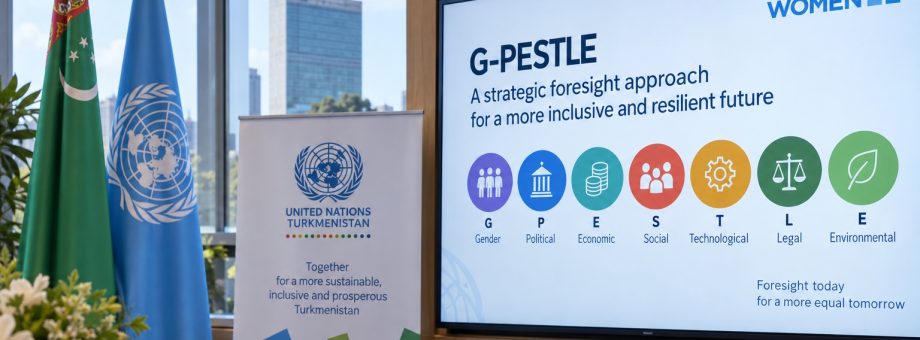
The United Nations Country Team (UNCT) in Turkmenistan has become the first UN Country Team globally to pilot the G-PESTLE framework, a new strategic foresight approach developed by UN Women.
The initiative was presented during a dedicated capacity-building session in Ashgabat in September 2026, bringing together representatives of UN agencies and international experts. The experience gained in Turkmenistan is expected to contribute to the development of practical tools and lessons that could potentially be applied more broadly across the United Nations development system.
What is G-PESTLE and why does it matter?
In simple terms, G-PESTLE is a strategic foresight methodology that helps decision-makers look ahead, identify emerging risks and opportunities, and take them into account in long-term planning.
Instead of examining a challenge from only one perspective, the methodology considers a broad range of interconnected factors — political, economic, social, technological, legal and environmental — while also assessing how emerging changes may affect different groups of society.
For example, developments related to climate change, water resources, labour markets or digital transformation can be examined together rather than separately. Such an approach can help identify potential challenges at an earlier stage, understand how developments in one area may influence another, and support more informed and forward-looking decisions.
The pilot is particularly significant as it forms part of a broader effort to institutionalize strategic foresight within the work of the UN Country Team in Turkmenistan. The methodology is expected to be incorporated into horizon scanning, country analysis and the implementation of the UN–Turkmenistan Cooperation Framework.
Turkmenistan as a platform for forward-looking approaches
The selection of the UN Country Team in Turkmenistan as the first globally to pilot G-PESTLE reflects the growing experience accumulated in the country in applying modern approaches to strategic analysis and long-term planning.
In recent years, the UN Country Team in Turkmenistan has progressively introduced strategic foresight, systems thinking and horizon scanning into its analytical work. These approaches have already been applied to such areas as energy transition, water availability, food security and sustainable development.
Importantly, the new pilot goes beyond a single training exercise. A practical G-PESTLE checklist is expected to be developed and tested during the forthcoming update of the UN Country Analysis. According to the United Nations, the experience could generate lessons and practical tools for wider application across the UN development system.
This provides another example of Turkmenistan serving as a platform where innovative and forward-looking approaches of the United Nations are tested in practice, while strengthening cooperation between the country and the UN system in support of sustainable development.
The initiative also complements Turkmenistan’s broader emphasis on preventive approaches, long-term planning and the achievement of the Sustainable Development Goals, demonstrating the value of applying modern analytical tools today to better anticipate the challenges and opportunities of tomorrow.
Source: United Nations in Turkmenistan, 15 September 2026. https://turkmenistan.un.org/en/322711-un-turkmenistan-strengthens-inclusive-foresight-capacity-through-g-pestle-deep-dive-session